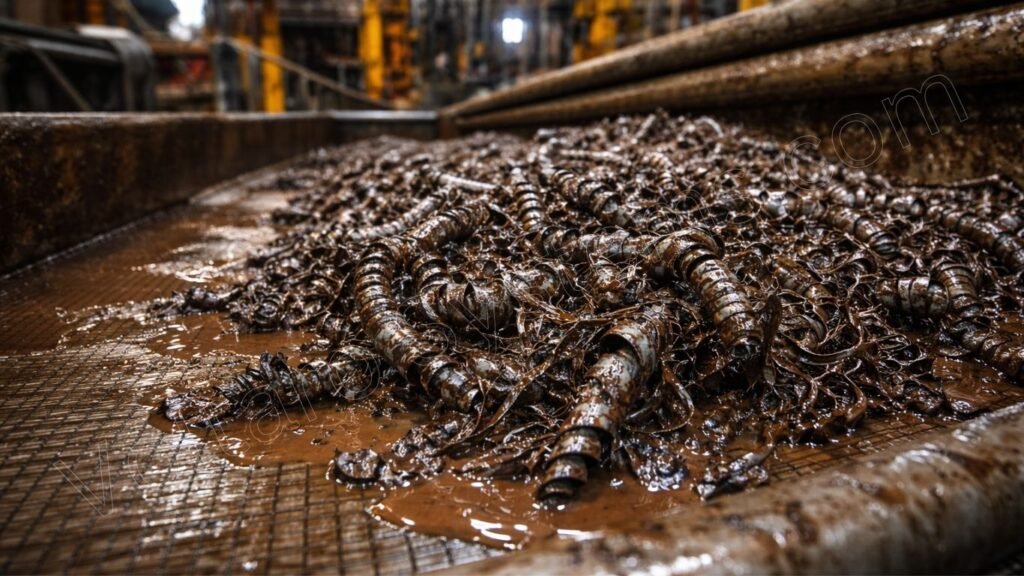
What Is a Flowline Ditch Magnet? The Foundation Answer.
A flowline ditch magnet is a magnetic separation device installed in the surface return drilling fluid channel — the flowline or header box — to remove ferrous metal particles (swarf) from the drilling fluid as it returns from the wellbore. Modern systems use permanent neodymium magnet rods held in a bespoke stainless steel frame spanning the full width and depth of the channel, ensuring all returning fluid passes through a high-intensity magnetic field. Ferrous particles are captured on the rod surfaces; non-ferrous material flows through to the shale shakers. Rods are periodically extracted and cleaned, removing swarf from the active fluid system.
The flowline ditch magnet sits at an interesting intersection in oilfield equipment design: it is one of the simplest devices on the rig, and simultaneously one of the most consequential. A strip of permanent magnets placed in a fluid channel. And yet whether that strip is the right specification — right Gauss rating, right temperature rating, right deployment geometry, right data capability — determines whether your pump runs for 150 days or 50, whether your MWD surveys are accurate or subtly biased, and whether your well integrity file has the evidence your regulator is starting to ask for.
This guide covers everything you need to know about flowline ditch magnets: the physics of how they work, how the technology evolved, where the current market standard sits and where it falls short, and exactly what a high-specification system looks like. If you’ve already read Article 1 in this series on what swarf is and what it costs, you have the context for why this equipment matters. If not, the related link at the end of this section will take you there.
The Basics: Why a Magnet, Not a Screen?
Shale shakers separate formation cuttings from drilling fluid by mechanical filtration — screens retain particles larger than the mesh aperture and pass smaller particles with the mud. This works for formation cuttings because the goal is to separate solids-by-size. It completely fails for swarf because swarf particles in the same size range as formation cuttings pass through the screen identically — shakers don’t know the difference between a 200-micron particle of limestone and a 200-micron particle of steel.
The distinguishing property of ferrous swarf is not its size but its material — specifically, it is ferromagnetic. A permanent magnet applies a selective force to ferromagnetic materials that does not apply to formation cuttings, baryte, calcium carbonate, or any other non-ferrous component of the drilling fluid. Magnetic separation is therefore the only method that selectively removes ferrous particles from the fluid stream regardless of particle size, independent of any other separation equipment on the rig.
The Physics of Magnetic Particle Separation — Explained Properly
Understanding the physics behind magnetic separation explains why the Gauss rating is the most important specification on a ditch magnet datasheet — and why the difference between 10,000 Gauss and 12,000 Gauss is not a marginal specification difference but a meaningful fine-particle-capture difference.
How a Particle Gets Captured
A ferrous particle suspended in moving drilling fluid is subject to two primary forces: the hydrodynamic drag force from the fluid flow, and the magnetic attractive force from the magnet. The particle is captured when the magnetic force exceeds the drag force.
The drag force on a spherical particle scales approximately with the particle’s cross-sectional area and the fluid velocity. The magnetic attractive force scales with the particle’s volume (proportional to the cube of its diameter) and the field gradient at the particle’s location.
Here is the critical insight: as particle size decreases, the drag-force-to-magnetic-force ratio worsens rapidly. This happens because volume decreases as the cube of diameter while cross-section decreases only as the square — meaning a particle that is half the diameter of another has one-quarter the cross-section but only one-eighth the volume. The smaller particle experiences proportionally less magnetic force relative to its drag than the larger particle.
This physics is the core reason why higher Gauss ratings capture finer particles.
- At 2,000 Gauss (legacy ceramic), reliable capture extends only to particles above approximately 500 microns.
- At 10,000–11,000 Gauss (market standard neodymium), capture extends to 100–150 microns.
- At 12,000+ Gauss (Swarfclean™ specification), reliable capture extends to approximately 50 microns — the finest fraction of drilling swarf that causes the most damage per gram to pump internals and sensor equipment.
Why Field Uniformity Matters
Gauss rating alone doesn’t fully determine capture efficiency. The geometry of the field matters too. A single magnet bar placed on a ditch floor creates a field that is strong immediately adjacent to the magnet surface and falls off rapidly with distance. Fluid flowing in the centre of the channel — at the highest velocity — is exposed to the weakest field and is the least likely to have its particles captured.
This is the second fundamental failure of the legacy ceramic block design. Even at its limited 2,000 Gauss rating, a floor-mounted block magnet is not exposing all of the fluid to its field — only the fraction that passes close to the magnet surface.
The rod-in-frame design addresses this completely. Multiple rods positioned at regular intervals across the full width and depth of the channel create a magnetic barrier that all returning fluid must pass through. There is no bypass path. Every litre of fluid passes close to at least one rod surface. Field coverage is complete.
How the Technology Evolved — Three Generations
Generation 1: The Ceramic Block Era (1970s to Present)
The ceramic block ditch magnet was the industry standard for swarf removal from roughly the 1970s until the 2000s, and it is still being used on some rigs today. Understanding its design explains why it fails in almost every dimension that matters for modern drilling operations.
In its basic form: one or more ceramic ferrite magnet blocks, housed in a steel plate or frame, placed in the open flowline ditch or on the ditch wall. The ceramic ferrite material — the same type used in loudspeaker magnets and refrigerator door seals — produces a maximum surface field of approximately 800 to 2,500 Gauss. At this field strength, the magnetic attractive force is sufficient to capture large particles (above 500 microns) at slow to moderate flow velocities. For fine particles — the 50–200 micron fraction that causes pump and sensor damage — the field is entirely insufficient to overcome fluid drag.
The cleaning process required the magnet block to be physically lifted — against its own attraction force toward the steel frame — and the accumulated swarf scraped from its surface by hand or with a tool. A 20 kg magnet block on a milling job, cleaned every 30 minutes over a 16-hour shift: 32 lifts per shift, each against a magnetic attraction force to the steel ditch. The manual handling injury profile this creates is entirely predictable and extensively documented.
Swarf was scraped off and discarded. No one measured it. No one logged it. The information content of that swarf — the story it told about casing wear rate and milling efficiency — was thrown in the skip with the mud.
“Lifting and cleaning the old block-type magnets is a nightmare for anyone doing it. With the new rod design, it’s done in ten minutes and no manual handling or mess, simple.”
Generation 2: The Neodymium Rod Revolution (2010s to Present)
The introduction of neodymium rare-earth magnets into oilfield swarf management was a genuine step change — not an incremental improvement. Neodymium Iron Boron (NdFeB) magnets produce field strengths five to ten times higher than ceramic ferrite alternatives, and in a rod-based deployment they simultaneously solve the field strength problem and the coverage geometry problem.
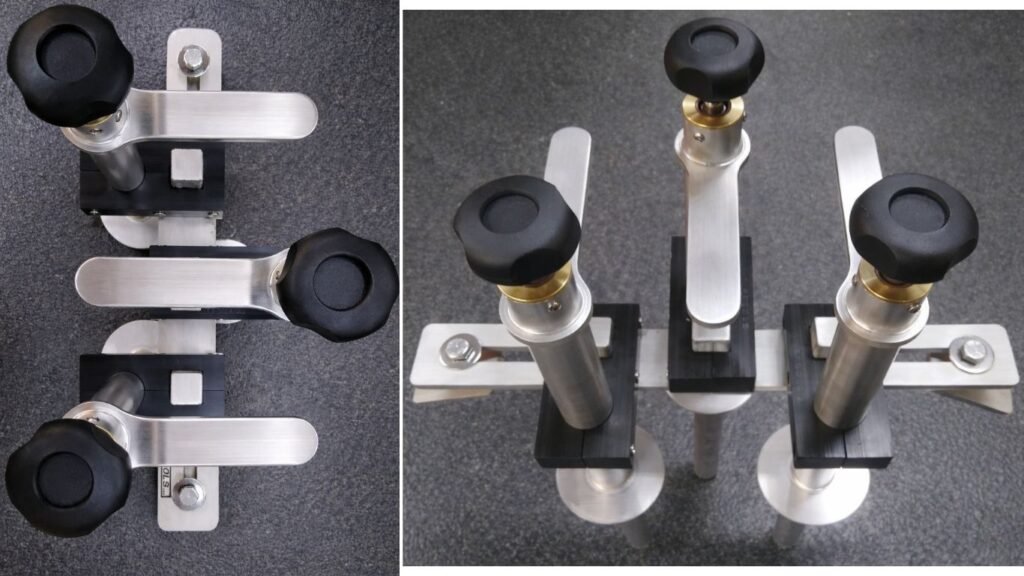
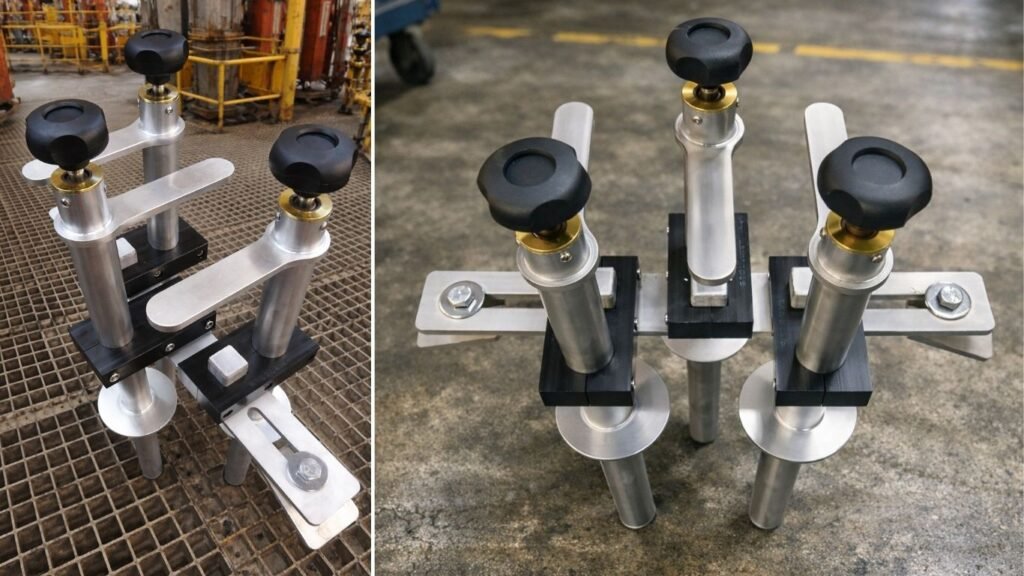
The modern rod format: neodymium magnet rods in a custom-fabricated frame spanning the full width and depth of the flowline channel. The frame creates a complete magnetic barrier — all returned fluid passes through the rod array, not over or around a floor-mounted plate. Rods are lightweight (under 4 kg each) and extracted by handle. Demagnetisation mechanisms release swarf into a collection vessel without hand contact.
The Market Standard’s Three Gaps
1. Temperature ceiling. Archer EZ-CLEAN standard: rated to 80°C. Above this threshold, NdFeB magnets of standard grades begin irreversible demagnetisation — permanent field strength loss with each thermal cycle above the limit. For Middle East, HPHT, and elevated-temperature operations, this is a specification that is routinely exceeded without detection. 2. No swarf data logging. Neither current market-leading product presents swarf weighing, timestamping, and depth-correlation as a product capability. The data that enables casing wear trending is not being captured. 3. Fine particle capture gap. At 10,000–11,000 Gauss, particles below 100 microns escape capture at practical flow velocities. This fraction is disproportionately responsible for pump erosion and MWD survey interference.
The Swarfclean™ Flowline Ditch Magnet: What’s Different
The Swarfclean™ Flowline Ditch Magnet is a neodymium rod-in-frame magnetic separation system that operates at 12,000+ Gauss (N48–N52 grade NdFeB magnets), carries a standard temperature rating of 120°C without requiring an upgrade specification, uses sealed SS304 austenitic rod casings for full fluid system compatibility, and includes an integrated swarf weighing and data logging system as a standard product component — the only flowline ditch magnet on the market to do so.
12,000+ Gauss: Why N48–N52 Grade Matters
NdFeB magnets are graded by their maximum energy product, measured in Mega Gauss Oersteds (MGOe). The grade number indicates this energy product: N35 delivers ~35 MGOe; N52 delivers ~52 MGOe. Higher grade = more stored magnetic energy = stronger field from the same physical size.
Most standard oilfield magnetic products use N35–N42 grade NdFeB materials, balancing performance against cost. The Swarfclean™ standard assembly uses N48–N52 grade — the highest commercially available range. This is what enables 12,000+ Gauss from a rod that still weighs under 4 kg and maintains a lightweight form factor identical to standard market-specification rods.
The practical consequence at the fluid: reliable capture of particles down to approximately 50 microns at typical milling return flow velocities. The sub-100-micron fraction — responsible for the progressive pump erosion and MWD survey bias described in Article 1 — is reliably captured. At 10,000–11,000 Gauss, this fraction is only partially captured and its escape into the recirculating fluid is the primary driver of the long-term equipment damage that swarf management is meant to prevent.
120°C Standard: Solving the Invisible Demagnetisation Problem
This is the specification difference that is most consequential for operators in elevated-temperature environments — and the one most likely to be generating problems right now on wells where the standard market product is deployed without awareness of the risk.
NdFeB magnets experience irreversible demagnetisation — permanent, non-recoverable reduction in field strength — when cycled above their maximum operating temperature. “Irreversible” is the key word: each heating event above the limit permanently reduces field strength. The magnet doesn’t fail; it gets progressively weaker well by well, job by job, with no indication to the operator that this is happening.
The Archer EZ-CLEAN MAGNOROD® standard product is rated to 80°C. In the Middle East, where ambient temperatures are high and flowlines run hot, and in HPHT environments where fluid temperatures are elevated, this rating is routinely exceeded. The operator who deploys a standard competitor rod in a 95°C flowline is running a slow demagnetisation experiment. By the third or fourth well campaign using the same rods, the effective field strength has dropped measurably — and the swarf capture performance has degraded proportionally, silently, without any surface indicator.
The Swarfclean™ standard assembly is rated to 120°C — a 40°C advantage over the market standard — achieved through selection of high-rated grade NdFeB materials with appropriate thermal demagnetisation coefficients. For environments above 120°C, the SmCo (Samarium Cobalt) magnet option sustains full performance to 250°C — interchangeable with the standard rods in the same frame, with no other changes required.
Integrated Swarf Data Logging: The Capability Nobody Else Has
Every Swarfclean™ deployment includes: a stainless steel collection vessel, pre-labelled swarf sample bags, a calibrated portable weighing scale, and a standardised log sheet with columns for swarf weight, cleaning time, and measured depth. These are not optional accessories. They are standard product components.
No other flowline ditch magnet on the market includes equivalent integrated logging capability as a standard product component. The swarf that competing products capture is weighed by nobody, timestamped by nobody, and correlated to depth by nobody. It goes into a collection bin and gets disposed of as waste, taking its information content with it.
What the Swarfclean™ log makes possible:
- Quantitative casing wear trending — swarf weight per cycle plotted against depth creates a continuous signature of casing contact force at every depth interval
- Real-time milling progress indicator — swarf weight per cycle during section milling is a direct proxy for milling rate, providing the drilling engineer a surface-measurable performance indicator that no other instrument provides
- P&A regulatory documentation — the timestamped log satisfies NORSOK D-010, UKCS OGUK, and NPD debris recovery documentation requirements as a standard output of routine operations
- HSE manual handling record — simultaneously documents that each cleaning cycle was completed within the zero-contact protocol, supporting COSHH assessment and HSE audit trail requirements
How the Swarfclean™ System Works — Step by Step
1. Install the Bespoke Frame
The SS304 stainless frame is placed in the open flowline channel or header box — fabricated to the exact width and depth of the channel geometry. Round-bottomed, rectangular, sloped, or header box: all supported. No welding, no modification, no specialist tools. Standard bracket covers 40–55 cm width; any dimension available on request. One crew member, under 15 minutes from arrival to rods-in-frame.
2. Insert the Neodymium Rods
Each sealed SS304 austenitic magnet rod is lowered into the frame, spanning the full channel depth and creating a complete magnetic barrier. Every litre of returned fluid must pass through the rod array — there is no bypass path. The sealed non-magnetic casing prevents mud contamination of the magnet material and ensures full OBM and SBM compatibility.
3. Continuous Magnetic Separation
The 12,000+ Gauss field gradient pulls ferrous particles from suspension onto the rod surfaces. Non-ferrous material — formation cuttings, baryte, calcium carbonate, LCM — flows through completely unaffected to the shale shakers. Zero backpressure, zero flow restriction, and zero moving parts in the separation zone. The system operates continuously without any attention until a cleaning cycle is due.
4. Extract Rods per Schedule
Every 30–60 minutes during milling; every 4–8 hours during routine drilling. Each rod is pulled individually by handle — a single smooth motion. The remaining rods continue separation without any interruption to fluid returns. The extraction doesn’t require stopping circulation, ceasing operations, or clearing the flowline area.
5. Zero-Contact Swarf Discharge
The extracted rod goes over the collection vessel. The demagnetisation mechanism releases swarf cleanly into the vessel. No scraping, no glove contamination, and no skin contact with swarf, contaminated mud, or rod surfaces. This is the designed operating mode, not a best-practice aspiration. The crew member’s hands are clean from extraction through to reinsertion.
6. Weigh, Log, Reinstate — Under 3 Minutes Total
Swarf goes onto the supplied calibrated scale. Weight, time, and current measured depth go onto the Swarfclean™ log sheet. Rod goes back in the frame. A full 3-rod frame installation: extracted, discharged, weighed, logged, and reinserted in under 3 minutes. The log accumulates as a continuous quantitative record of swarf recovery across the full well — every cycle, every hour, from spud to total depth.
Technical Specifications
| Parameter | Standard Specification |
|---|---|
| Product | Swarfclean™ Flowline Ditch Magnet |
| Magnet Type | Neodymium Iron Boron (NdFeB) — Permanent Magnet |
| Magnet Grade | N48–N52 (highest commercial energy-product grade) |
| Field Strength at Rod Face | ≥ 12,000 Gauss (1.2 Tesla) |
| Minimum Particle Capture | ~50 microns (ferrous particles) |
| Rod Casing Material | AISI 304 Austenitic Stainless Steel — non-magnetic, sealed |
| Frame Material | AISI 304 Stainless Steel |
| Standard Temperature Rating | 120°C (248°F) — NdFeB standard configuration |
| Rod Weight | ~4 kg per rod |
| Standard Frame Configuration | 3-rod frame, 40–55 cm channel width (bespoke any size) |
| Fluid System Compatibility | WBM · OBM · SBM · Brine — all standard drilling fluid systems |
| Manual Swarf Contact Required | None |
| Swarf Logging Equipment (Standard) | Collection vessel · Pre-labelled sample bags · Calibrated scale · Log sheet |
| Installation Time | Under 15 minutes — no welding, no flowline modification |
| Power Requirement | None (passive permanent magnet assembly) |
Why Austenitic SS304 Rod Casing Is Non-Negotiable?
This specification detail is rarely discussed in product marketing but directly determines field performance. If the rod casing is made from ferritic (magnetic) steel — or even ferritic stainless steel — it acts as a magnetic flux short-circuit, diverting field lines into the casing wall rather than projecting them into the fluid path. A magnetic rod casing can reduce effective external field strength by 40–70%, regardless of what the magnet specification states. When evaluating competing products, confirm explicitly that the casing material is austenitic (non-magnetic) stainless steel — SS304 or SS316. “Stainless steel” without the austenitic qualification is insufficient.
The Three-Way Comparison: Legacy · Market Standard · Swarfclean™
The table below compares all three technology tiers present in the current oilfield ditch magnet market. Competitor specifications are sourced from publicly available product documentation and attributed accordingly.
| Comparison Factor | Rectangular Block Magnet | Current Market Standard | Swarfclean™ Flowline Ditch Magnet |
|---|---|---|---|
| Magnetic Field Strength | 800–2,500 Gauss (ceramic) | 9,000–11,000 Gauss | ✓ 9,000+ Gauss (N48–N52 NdFeB) |
| Fine Particle Capture | ~500 microns and above only | ~100–150 microns | ✓ ~50 microns and above |
| Manual Swarf Contact | Yes — scraping by hand required | ✓ Zero contact (piston/handle discharge) | ✓ Zero contact — handle-actuated rod extraction |
| Rod / Unit Weight | 15–40 kg block (manual lift hazard) | ✓ ~4 kg per rod | ✓ ~4 kg per rod |
| Standard Temperature Rating | 60–80°C (ceramic degrades) | 80°C standard / 150°C HT option | ✓ 120°C standard / 250°C SmCo option |
| Full Cross-Section Coverage | No — floor/wall placement only | ✓ Yes — rod frame spans full channel | ✓ Yes — bespoke frame for any geometry |
| Cleaning Cycle — Full Frame | 5–20 minutes (scraping) | ~5–10 minutes (multiple rods) | ✓ Under 3 minutes (full frame) |
| Swarf Data Logging | None — swarf discarded | Not standardised — no protocol included | ✓ Built-in — weighed, time-stamped, depth-correlated |
| OBM/SBM Compatibility | Poor — surface absorbs mud | ✓ Good — sealed SS casing | ✓ Good — sealed SS304 casing |
| Bespoke Frame Fabrication | No | ✓ Yes | ✓ Yes — all channel geometries |
| Total Cost of Operation | Low CAPEX; high damage, safety, and NPT cost | Good — reduced NPT risk, no data value | ✓ Best TCO — lowest damage risk + data asset |
Applications by Well Type and Operation
Section Milling and Sidetracking — The Primary Use Case
The highest swarf generation rate, the greatest need for high-Gauss fine particle capture, and the strongest argument for quantitative swarf logging as a real-time milling performance indicator. A Swarfclean™ system on a 30–60 minute cleaning schedule captures the full particle size distribution during milling returns and provides the drilling engineer with continuous swarf production data that tracks directly against milling rate — a performance indicator available from no other surface measurement.
Plug and Abandonment Campaigns
Multiple casing string mills, large cumulative swarf volumes, and increasingly demanding regulatory documentation requirements. The Swarfclean™ swarf log maps directly to NORSOK D-010, UKCS OGUK Well Examination Scheme, and NPD P&A regulatory requirements for debris recovery verification — produced automatically as a standard output of routine operations.
High-Temperature Land Drilling (Middle East, North Africa)
The environment where the temperature specification gap between Swarfclean™ and market-standard competitors is most consequential. The 120°C standard configuration eliminates irreversible demagnetisation risk in environments where flowlines regularly exceed 80°C — without requiring a HPHT upgrade specification or a price premium.
Offshore Floaters and Jackups
MARPOL Annex V compliance requires containment of metallic waste. The Swarfclean™ collection vessel system satisfies this with swarf bagged and labelled for the rig’s MARPOL-compliant solid waste stream. ATEX Zone 1 and 2 certified optional accessories satisfy offshore hazardous area requirements.
Horizontal and Extended-Reach Drilling
Continuous low-level casing wear swarf accumulates across hundreds of hours of horizontal drilling. Extended cleaning intervals (4–8 hours during non-milling phases) make continuous deployment economical — preventing the cumulative fluid contamination that milling-only deployment strategies miss entirely.
HPHT and Geothermal Wells
The SmCo magnet option sustains full 12,000+ Gauss performance to 250°C — extending Swarfclean™ capability into environments where standard NdFeB assemblies cannot be reliably deployed. Rod-for-rod interchangeable with the standard assembly in the same frame.
The Buying Guide: Six Questions That Separate Products
The ditch magnet market lacks the transparency of other oilfield equipment categories. Specifications are sometimes implied rather than stated, temperature ratings may not disclose the NdFeB grade behind them, and “data logging capability” can mean a collection bin with no protocol. These six questions will differentiate products on measurable criteria.
Q1- What is your measured Gauss rating at the rod face — and can you provide a measurement certificate?
The current market standard (Archer EZ-CLEAN MAGNOROD® published specification) is 10,000–11,000 Gauss at the rod face. Any supplier claiming significantly higher should support the figure with a third-party gaussmeter measurement certificate, not a manufacturer’s calculated value. Below 8,000 Gauss should be considered inadequate for section milling applications.
Q2- What is your standard temperature rating — and what NdFeB grade achieves it?
The Archer EZ-CLEAN standard product is rated to 80°C. If your operation regularly involves flowline temperatures above 80°C — Middle East land wells, HPHT environments — you need a higher standard rating. Ask which NdFeB grade achieves the stated temperature rating; a supplier who can’t answer this question probably can’t guarantee the rating holds across multiple thermal cycles. Swarfclean™ standard: 120°C (N48–N52 NdFeB).
Q3– What swarf logging equipment is included as standard product components?
A complete logging system includes: a calibrated weighing scale, pre-labelled collection vessels, and a log sheet capturing weight, time, and measured depth as a minimum. “We have a collection bin” is not a logging system — it is a bin. If this capability is not included as standard, it is not available from that supplier. Swarfclean™ includes all logging equipment as a standard product component.
Q4– Is the rod casing explicitly austenitic (non-magnetic) stainless steel?
Confirm SS304 or SS316 — not simply “stainless steel.” A ferritic or magnetic casing material short-circuits the magnetic field and can reduce effective external field strength by 40–70%, regardless of the magnet specification. This is a performance-critical material specification that is rarely highlighted in marketing materials but consistently matters in field performance.
Q5– Can you fabricate a bespoke frame for our specific channel geometry — and what is your lead time?
Both Swarfclean™ and the leading market-standard products offer custom frame fabrication. Confirm the supplier can accommodate your specific channel geometry (including round-bottomed and sloped channels) and the lead time for frame delivery. On tight well programme schedules, a 4-week versus 1-week fabrication lead time may determine whether the right equipment is on site for the milling job.
Q6– What ATEX certification applies to electrical accessories for offshore deployment?
The passive magnet rod assembly does not require ATEX certification. Any connected electrical accessories — load cells, RFID loggers, data transmitters — must be ATEX Zone 1 and Zone 2 certified (IECEx compliant) for offshore or classified onshore installation. Confirm which specific accessories carry this certification and which do not before specifying for offshore deployment.
Frequently Asked Questions
A flowline ditch magnet is a surface magnetic separation device installed in the return drilling fluid channel to remove ferrous swarf before it damages pump internals, BHA tools, and MWD sensors. Modern systems use neodymium magnet rods in a bespoke frame spanning the full channel cross-section, capturing particles as fine as 50 microns with no backpressure.
Permanent neodymium magnets generate a high-intensity field in the flowline channel. As drilling fluid passes through, ferrous particles experience a magnetic attractive force that — when it exceeds the fluid’s drag force — pulls them onto the rod surface. Higher Gauss ratings capture finer particles at higher flow velocities.
NdFeB magnets permanently lose field strength when operated above their rated temperature — a process that is cumulative and invisible. The Archer EZ-CLEAN standard is rated to 80°C. In Middle East or HPHT environments above this, standard competitor rods silently degrade well by well. Swarfclean™ at 120°C standard eliminates this risk without an upgrade.
Yes, provided the rod casing is sealed. Swarfclean™ uses sealed SS304 austenitic rod casings that prevent OBM or SBM from contacting the magnet material. All rod assemblies are fully compatible with WBM, OBM, SBM, and brine as standard.
Every 30–60 minutes during active milling. Shorten the interval if a single cycle produces more than 2 kg of swarf — rod saturation reduces capture efficiency. The Swarfclean™ 3-rod frame completes a full cleaning cycle in under 3 minutes, making frequent intervals operationally straightforward.
A magnetic (ferritic) rod casing acts as a flux short-circuit, diverting the magnet’s field into the casing metal rather than the fluid path. This can reduce effective external field strength by 40–70%, regardless of the magnet specification. SS304 austenitic stainless steel is non-magnetic — it lets the full field reach the fluid.
The passive magnet rod assembly requires no ATEX certification. Any electrical accessories — load cells, RFID loggers, data transmitters — must be ATEX Zone 1 and Zone 2 certified (IECEx compliant). Swarfclean™ optional digital accessories are ATEX Zone 1 and 2 certified as standard.
A single avoided pump rebuild on an offshore floater — typically 6+ hours NPT at $150,000/hr plus parts — exceeds the cost of a full Swarfclean™ deployment campaign. On any well involving section milling, the probability of at least one swarf-related equipment event without adequate magnetic separation makes the ROI case effectively guaranteed.